Document 03
Martyn's Law invacuation procedure template
What to do when the danger is outside and people are safer inside: bringing everyone in, closing the doors, moving away from windows and staying put until the police say otherwise.
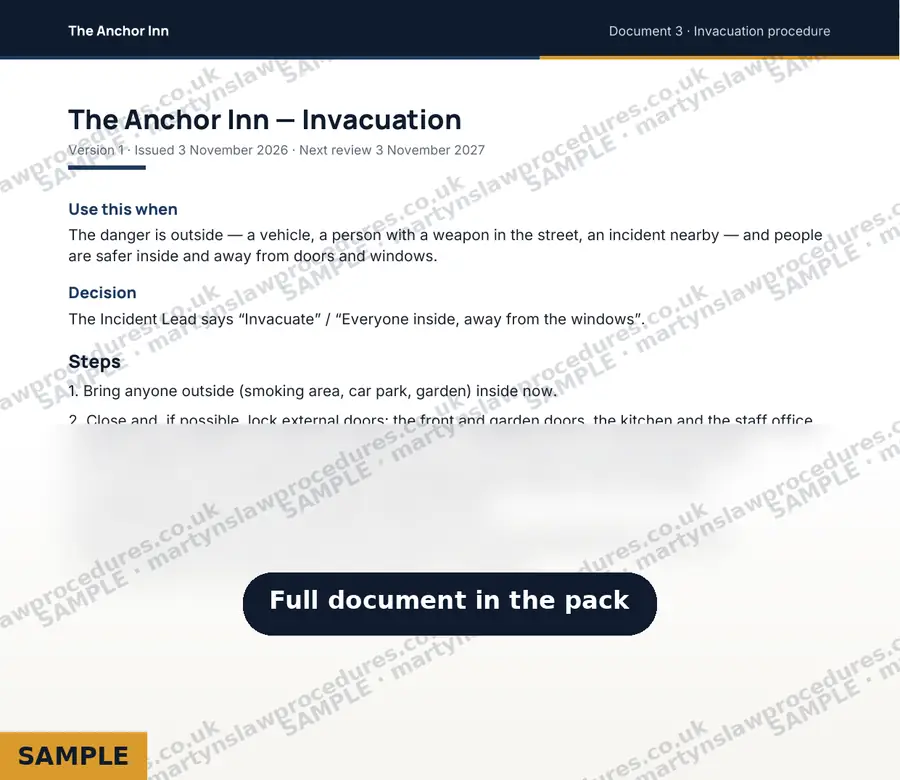
About the sample
Responsible person: Anchor Inns Ltd trading as The Anchor Inn. Lead contact: Sam Reid, General Manager. Capacity: 320, worked out by method A (fire safety occupancy figure).
Formats
Your version comes as PDF and Word, branded with your venue's name.
What is an invacuation procedure?
Invacuation is the opposite of evacuation. Instead of getting people out, you bring them inside and move them away from the danger. It is the right response when the threat is outside the building: a vehicle, a person with a weapon in the street, or an incident nearby.
Invacuation is one of the four public protection procedures named in Martyn's Law. It is the one most venues have never thought about, because it plays no part in a fire plan.
What does Martyn's Law expect?
At standard tier, the responsible person must have appropriate procedures in place, so far as reasonably practicable, to reduce the risk of physical harm if an attack happens on the premises or in the immediate vicinity. An attack nearby is specifically within scope, which is why the Act expects you to plan for bringing people in as well as getting them out.
What's in the template
- When to use it: the danger is outside and people are safer indoors
- Who decides: the Incident Lead says "Invacuate" or "Everyone inside, away from the windows"
- Bringing in anyone outside, such as a smoking area, garden or car park
- Closing and, where possible, locking external doors
- Moving people to your named safe areas, away from windows and glass doors
- Turning off music so people can hear instructions
- Calling 999 to say you have people inside and where they are
- Keeping everyone inside until the police say otherwise, and switching to evacuation or lockdown if the danger moves inside
Who uses it, and when
Staff who work near the entrance, the garden or the smoking area are often first to see trouble outside, so they need to know this procedure well. The Incident Lead decides, but anyone who sees an obvious danger should start bringing people in.
How it fits with the other documents
Invacuation often comes first and may turn into something else. If the danger moves inside, switch to the evacuation procedure or the lockdown procedure. The invacuation announcement is in the communication procedure, and your safe areas appear on the wall poster.
Questions about this document
What makes a good safe area?
A space away from the main entrance, with solid walls and as little glass as possible, large enough for the people you expect. A function room, a back room, a vestry or changing rooms often work.
What if people want to leave?
The procedure asks staff to keep people inside until the police say otherwise, and not to let anyone go out "just to look". Explain calmly that it is safer inside for now.
Is invacuation the same as lockdown?
They overlap. Both involve closing doors, but invacuation is about bringing people in when the danger is outside. Lockdown is about stopping an attacker reaching people, including when they are already inside.
Does Martyn's Law apply to your venue?
Six questions. Free. No account needed.