Document 02
Martyn's Law evacuation procedure template
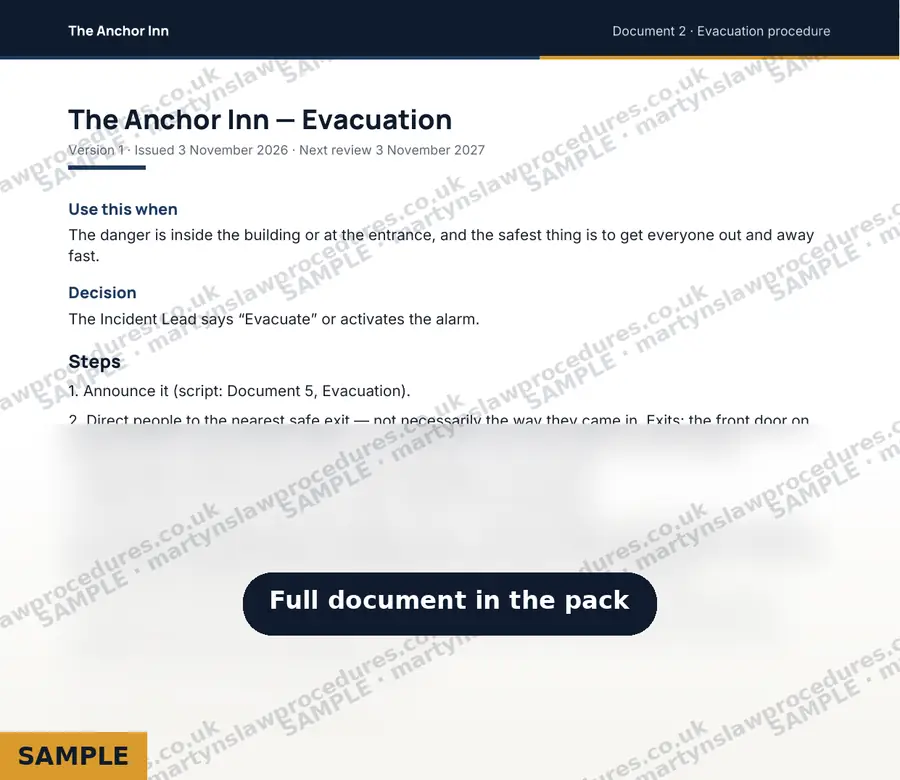
What to do when the danger is inside the building or at the entrance, and the safest thing is to get everyone out and away quickly. Written around your own exits and assembly points.
About the sample
Responsible person: Anchor Inns Ltd trading as The Anchor Inn. Lead contact: Sam Reid, General Manager. Capacity: 320, worked out by method A (fire safety occupancy figure).
Formats
Your version comes as PDF and Word, branded with your venue's name.
What is an evacuation procedure under Martyn's Law?
An evacuation procedure sets out how you get people out of the building and away from danger. Under Martyn's Law it is one of four public protection procedures the responsible person must have in place at standard tier, so far as reasonably practicable.
It is different from a fire evacuation. In a fire, everyone heads for the nearest exit and gathers at the assembly point. In an attack, the nearest exit may be where the danger is, and a crowd standing just outside the door may still be at risk. The procedure has to account for both.
What's in the template
- When to use it: the danger is inside the building or at the entrance
- Who decides: the Incident Lead says "Evacuate" or activates the alarm
- Eight steps, from the announcement to staying out until the police say it is safe
- Your exits, named, with a reminder that the safest way out may not be the way people came in
- Primary and secondary assembly points, and an instruction to keep going if the danger is close
- What to tell 999: that it is an attack, the address, what you saw, how many people and where they are
- Helping children, wheelchair users, older people and anyone who cannot move quickly
- Three things that commonly go wrong without a plan
Who uses it, and when
The Incident Lead and any member of staff who sees an obvious danger inside. Staff at each exit hold doors and keep people moving. Use it to brief your team, and walk the exits with them so everyone knows which doors open from the inside.
How it fits with the other documents
Evacuation is one of three options. If the danger is outside, use the invacuation procedure. If an attacker is inside and you cannot get people out safely, use the lockdown procedure. The announcement and 999 scripts are in the communication procedure, and the essentials are on the staff briefing sheet.
Questions about this document
Can we use our fire evacuation plan instead?
Your fire plan is a good starting point, and it overlaps with this procedure. But an attack is different: people may need to avoid certain exits and keep moving beyond the usual assembly point. This procedure adds those decisions.
How far away should people go?
There is no fixed safe distance in the guidance. The aim is to get clear of the immediate vicinity, so the procedure tells staff to keep people moving past the assembly point if the danger is close.
Who can call an evacuation?
The Incident Lead normally decides. Anyone who sees an obvious and immediate danger should act without waiting for permission.
Does Martyn's Law apply to your venue?
Six questions. Free. No account needed.