Document 01
Martyn's Law public protection procedures template
The master document in the pack. It records your premises, the responsible person, your four procedures, who takes charge on the day, and how your procedures are briefed and reviewed.
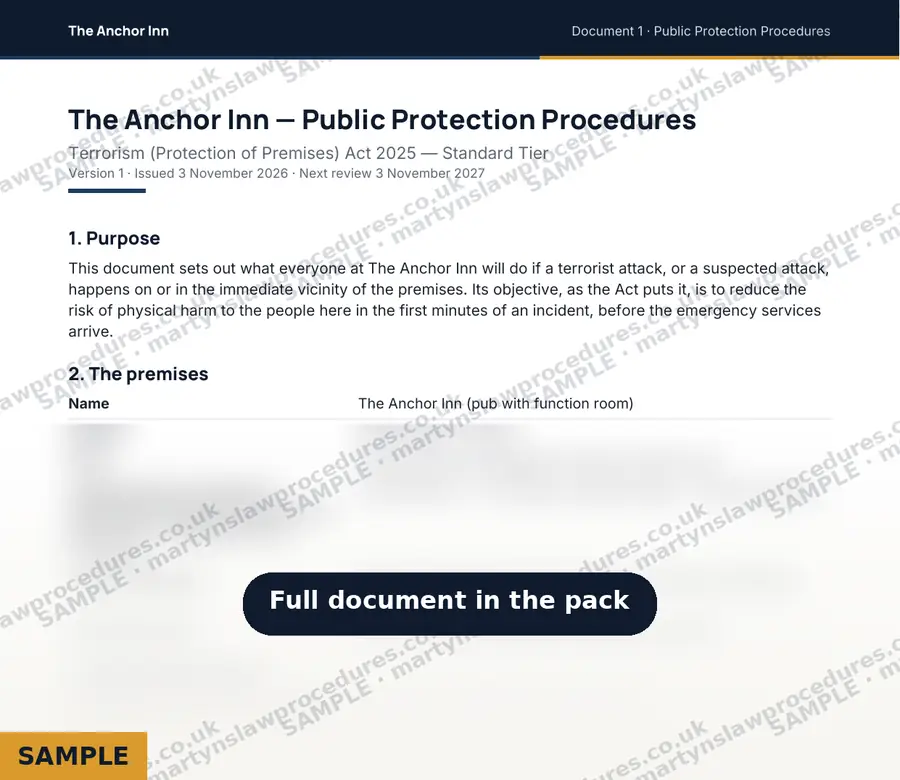
About the sample
Responsible person: Anchor Inns Ltd trading as The Anchor Inn. Lead contact: Sam Reid, General Manager. Capacity: 320, worked out by method A (fire safety occupancy figure).
Formats
Your version comes as PDF and Word, branded with your venue's name.
What is a public protection procedures document?
It is the document that pulls your whole plan together. It sets out what everyone at your venue will do if a terrorist attack, or a suspected attack, happens on the premises or nearby. It names the organisation responsible, describes the building and the number of people you expect, and points to the four detailed procedures that follow it in the pack.
If someone asks what your venue has in place under Martyn's Law, this is the document to show them first.
What does Martyn's Law expect?
At standard tier, the responsible person must have appropriate public protection procedures in place, so far as reasonably practicable, covering evacuation, invacuation, lockdown and communication. The objective is to reduce the risk of physical harm to people if an attack happens. The law does not require you to write these down, but the statutory guidance says documenting even simple procedures is good practice, and that staff should know the procedures and how to carry them out.
What's in the document
- Purpose: what the procedures are for, in the Act's own terms
- The premises: name, address, floors, expected numbers, the method used and your tier
- Responsible person: the organisation that holds the legal duty, the lead contact who acts for it, and a deputy
- Your four procedures and when each one is used
- Who is in charge on the day: the Incident Lead, and what they do
- Where people go: assembly points, safe areas and lockable rooms
- How you tell people: alarm, announcements and staff communication
- First aid, the nearest hospital, and a grab bag with contacts, staff lists and a floor plan
- How the procedures are briefed and reviewed
- A guiding rule that supports staff who act in good faith
Who uses it, and when
The lead contact keeps it, reviews it every year and after any change, and uses it to brief managers, committee members and new staff. It is also the document you would show the SIA, your insurer or a hirer who asks what you have in place.
How it fits with the other documents
Document 1 is the hub. The evacuation, invacuation, lockdown and communication procedures give the step-by-step detail. Your tier comes from the capacity assessment record, and your briefings and reviews are recorded in the briefing and review log.
Questions about this document
Who should be named as the responsible person?
The organisation or person that controls the premises: for example a pub company, a parochial church council, a school governing body or a village hall committee. It is usually an organisation rather than an individual. The document also names the person who acts for it day to day.
Is the Incident Lead a legal role?
No. The Incident Lead is the most senior person on site at the time, and the role is an operational arrangement. Legal responsibility stays with the responsible person and cannot be delegated to a contractor, a hirer or a member of staff.
How often should it be reviewed?
At least once a year, and whenever the building, the way it is used or the people involved change, as well as after any incident or near miss.
Does Martyn's Law apply to your venue?
Six questions. Free. No account needed.