Document 09
Martyn's Law capacity assessment record template
How you worked out the number of people it is reasonable to expect at the same time, using the Home Office methods A to F, and the tier that results. The SIA may ask for this record.
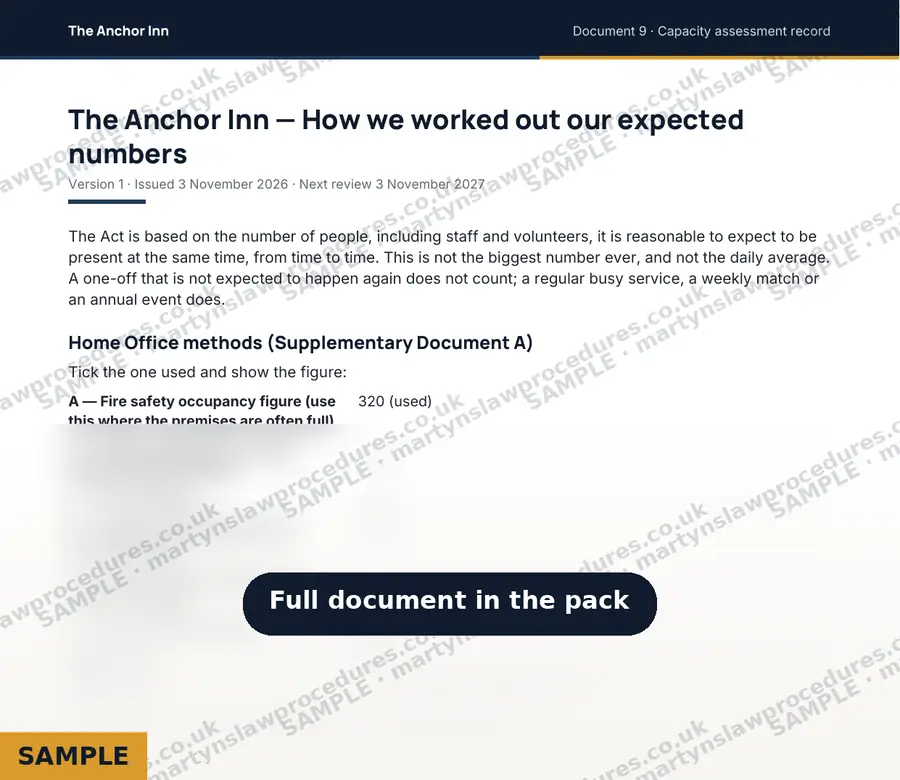
About the sample
Responsible person: Anchor Inns Ltd trading as The Anchor Inn. Lead contact: Sam Reid, General Manager. Capacity: 320, worked out by method A (fire safety occupancy figure).
Formats
Your version comes as PDF and Word, branded with your venue's name.
Why does capacity matter under Martyn's Law?
Whether the law applies to your premises, and which tier, depends on one figure: the number of people it is reasonable to expect on the premises at the same time, from time to time. That figure includes staff and volunteers as well as the public.
It is not the biggest crowd you have ever had, and it is not your daily average. It is your busiest regular period. A busy weekly service, a match day or an annual event counts because it comes round again. A genuine one-off that is not expected to happen again does not.
What are the Home Office methods?
The Home Office describes six methods in its supplementary guidance. You choose the one that best fits your premises and record why.
- A: Fire safety occupancy figure. Best where the premises are often full.
- B: Historic attendance records for your busiest regular period.
- C: Fixed seating, plus staff.
- D: Tickets or bookings sold for recurring events.
- E: A restriction on numbers, such as a licence condition.
- F: Another method you can justify.
What's in the template
- A plain explanation of the "reasonable to expect" test
- All six methods, with the one you used marked and its figure shown
- Your figure and method, and space for your reasoning
- The tier rules: under 200 out of scope, 200 to 799 standard tier, and 800 or more enhanced tier for most premises
- A note that places of worship, nurseries and childcare, schools and further education colleges are standard tier at any number of 200 or more
- A note on qualifying events of 800 or more
- Your result, and who assessed it and when
Who uses it, and when
The lead contact completes it for the responsible person, and checks it at every annual review or whenever your use of the building changes. The SIA can ask how you reached your figure, so keep the evidence you relied on, such as your fire risk assessment, attendance records or licence.
How it fits with the other documents
Your figure and tier flow into the public protection procedures and the responsible person and SIA notification record. For worked examples of each method, read how to work out your capacity, or use the free checker.
Questions about this document
Do I count staff and volunteers?
Yes. The figure includes everyone on the premises in connection with its use, not just members of the public.
What if our figure is just under 200?
Use the method that best reflects your busiest regular period, record your reasoning and review it if things change. Do not choose a method just because it gives a lower number. Many venues just under the line choose to have procedures anyway.
Our building has offices or flats as well. Do they count?
Only the part used for a purpose listed in the Act, such as the public-facing shop, café or hall, is counted.
Does Martyn's Law apply to your venue?
Six questions. Free. No account needed.