Document 04
Martyn's Law lockdown procedure template
What to do when an attacker is inside or about to enter and you cannot get everyone out safely: securing the building or part of it, calling 999 when you cannot speak, and the checks to make before an incident.
About the sample
Responsible person: Anchor Inns Ltd trading as The Anchor Inn. Lead contact: Sam Reid, General Manager. Capacity: 320, worked out by method A (fire safety occupancy figure).
Formats
Your version comes as PDF and Word, branded with your venue's name.
What is a lockdown procedure?
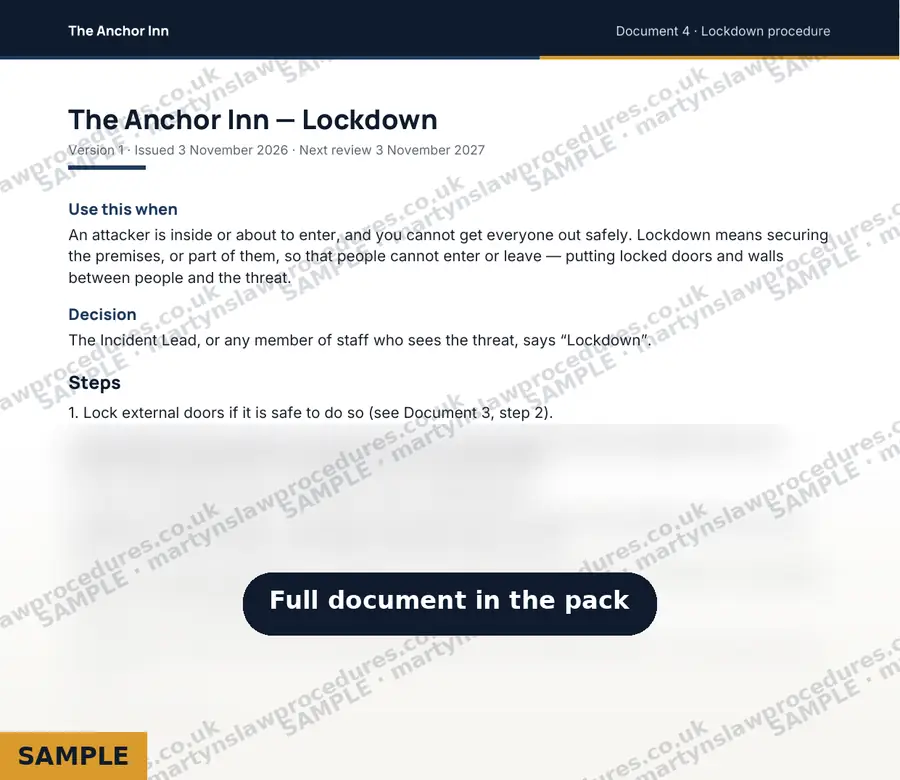
Lockdown means securing the premises, or part of them, so that people cannot enter or leave. In practice that means putting locked doors and solid walls between people and the threat. It covers locking external doors to keep an attacker out, and moving people into rooms that can be locked or barricaded if an attacker is already inside.
Lockdown is one of the four public protection procedures named in Martyn's Law. The Act describes it as procedures for preventing people from entering or leaving the premises.
What's in the template
- When to use it: an attacker is inside or about to enter, and you cannot get everyone out safely
- Who decides: the Incident Lead, or any member of staff who sees the threat, says "Lockdown"
- Locking external doors, if it is safe to do so
- Moving people into your named lockable rooms and safe areas
- Locking or barricading the door, turning lights off, silencing phones and staying out of sight
- A reminder that cover from view does not mean you are safe, so stay behind solid walls where possible
- Calling 999 if you cannot speak: stay on the line, listen to the call handler and press 55 when prompted
- Not opening the door until you are certain it is the police
- The police advice if the attacker gets in: Run if you can, Hide if you can't, Tell the police when it is safe
- Checks to make before an incident, such as which doors lock from the inside
Who uses it, and when
Everyone needs to know the word "Lockdown" and where the nearest lockable room is. The lead contact uses the "before an incident" checks to walk the building, fit simple bolts where needed and record the result in the review log.
How it fits with the other documents
Lockdown is the option for when getting out is not safe. The evacuation procedure and invacuation procedure cover the other two situations. The communication procedure holds the lockdown announcement and a code word so staff can call a lockdown without alarming an attacker.
Questions about this document
How do I call 999 if I can't speak?
Dial 999 from a mobile and stay on the line. Listen to the call handler and press 55 when prompted. This is known as the Silent Solution.
Our building has very few rooms that lock. What then?
Identify the most solid rooms you have, such as a kitchen, store, office or cellar, and consider fitting a simple bolt. Be realistic about what can be secured quickly, and record your checks in the review log.
Does lockdown mean locking customers in?
No. The aim is to keep the threat away from people. Locking external doors keeps an attacker out; it should never trap people inside with the danger.
Does Martyn's Law apply to your venue?
Six questions. Free. No account needed.